
Wellness League
Corporate wellness for small and medium-sized businesses
When discussing corporate wellness, large corporations usually come to mind. However, for small and medium-sized businesses, employee health often holds the greatest significance.
Today, over 29 million people work in the small and medium-sized enterprise sector, which accounts for more than 20% of Russia's economy. Small and medium-sized businesses are not just an addition to the country's economy; they are one of its key pillars.
However, most existing corporate programs were originally created for large companies. This area has been addressed for many years by specialists from the State Scientific Research Center for Preventive Medicine (now the National Medical Research Center for Therapy and Preventive Medicine). Large businesses have it easier: they have their own medical services, trade unions, occupational safety departments, and dedicated budgets.
Small and medium-sized businesses often find themselves alone with these challenges.
And it is here that the cost of an employee's illness is most noticeable.
If a team consists of 15 to 30 people, the absence of even one specialist can affect project deadlines, customer service quality, revenue, and the workload on colleagues.
Therefore, a modern corporate wellness program is not a luxury or a matter of image. It is a risk management tool.
What does the employer gain?
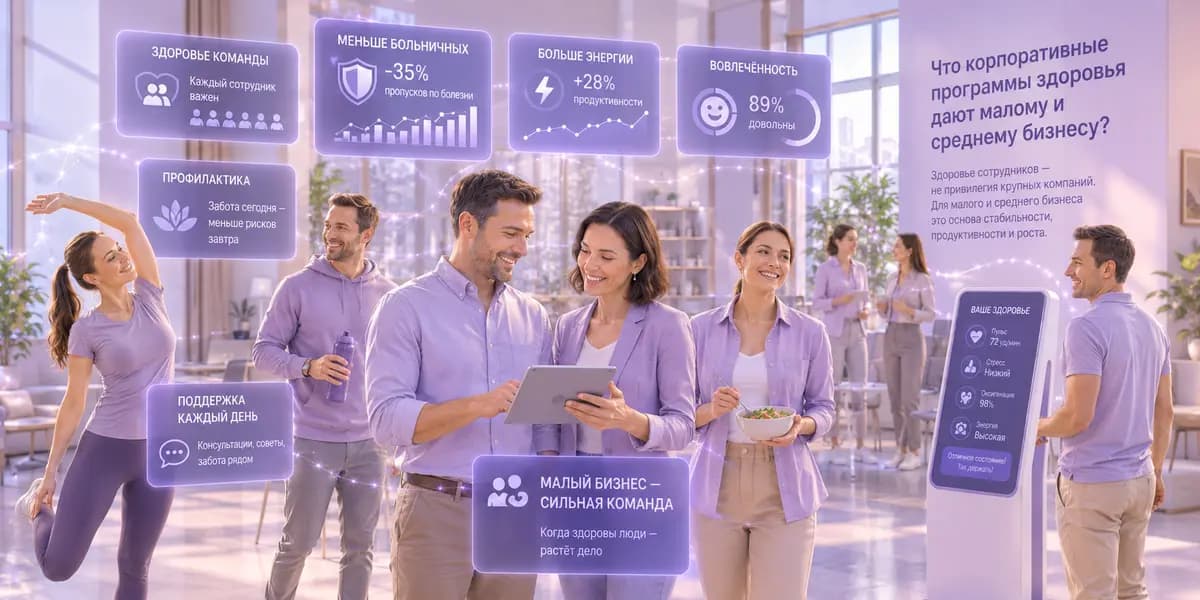
✅ Reduction in temporary disabilities and associated losses.
✅ Increased employee productivity through timely identification of risk factors.
✅ Higher levels of employee engagement.
✅ An additional factor for retaining valuable specialists.
✅ Increased authority for the leader who demonstrates genuine care for people.
✅ Strengthening team cohesion through shared goals and joint participation in wellness programs.
It is especially important that modern digital technologies allow for the development of programs without a medical office on-site and without significant costs. Personal recommendations, health potential assessments, habit tracking, and individual development trajectories can operate daily through digital services and artificial intelligence.
There is also an economic aspect to consider.
Expenses for occupational safety, prevention, and employee health improvement activities can be accounted for in the organization's expenses under current legislation and can reduce the taxable base when established requirements are met.
But the main point is not even this.
Practice shows that the benefits from increased labor productivity, reduced employee turnover, decreased sick leave, and the preservation of professional longevity often significantly exceed the initial investments in the program.
Employee health is not a cost item.
It is one of the most undervalued assets of small and medium-sized businesses.